
Your systems seem secure, but what if an attacker is already inside? A backdoor attack is one of the most dangerous cyber threats because it hides in plain sight.
Attackers slip in unnoticed, steal data, and maintain control for months without triggering a single alert.
Understanding what is a backdoor, how it works, how it spreads, and how to stop it could be the difference between a secure network and a costly breach. Organizations of all sizes are at risk, and the threat is growing every year.
Read on to stay ahead of the threat.
What is a Backdoor Attack?
A backdoor attack is a type of cyberattack where an attacker bypasses normal security measures to gain unauthorized access to a system, network, or software.
Instead of exploiting obvious weaknesses, the attacker adds a hidden entry point, or backdoor, to access the system, steal data, or install malware.
Backdoor attacks can be introduced through malicious software, weak passwords, or even insider access, and they often remain unnoticed for long periods, making them especially dangerous.
These attacks can affect computers, servers, and even IoT devices, giving attackers persistent access and control over the target system.
Backdoor attacks are often associated with:
- Command-and-control (C2) communication
- Persistent remote access
- Credential abuse
- Lateral Movement across networks
What Can a Backdoor Attack Do?
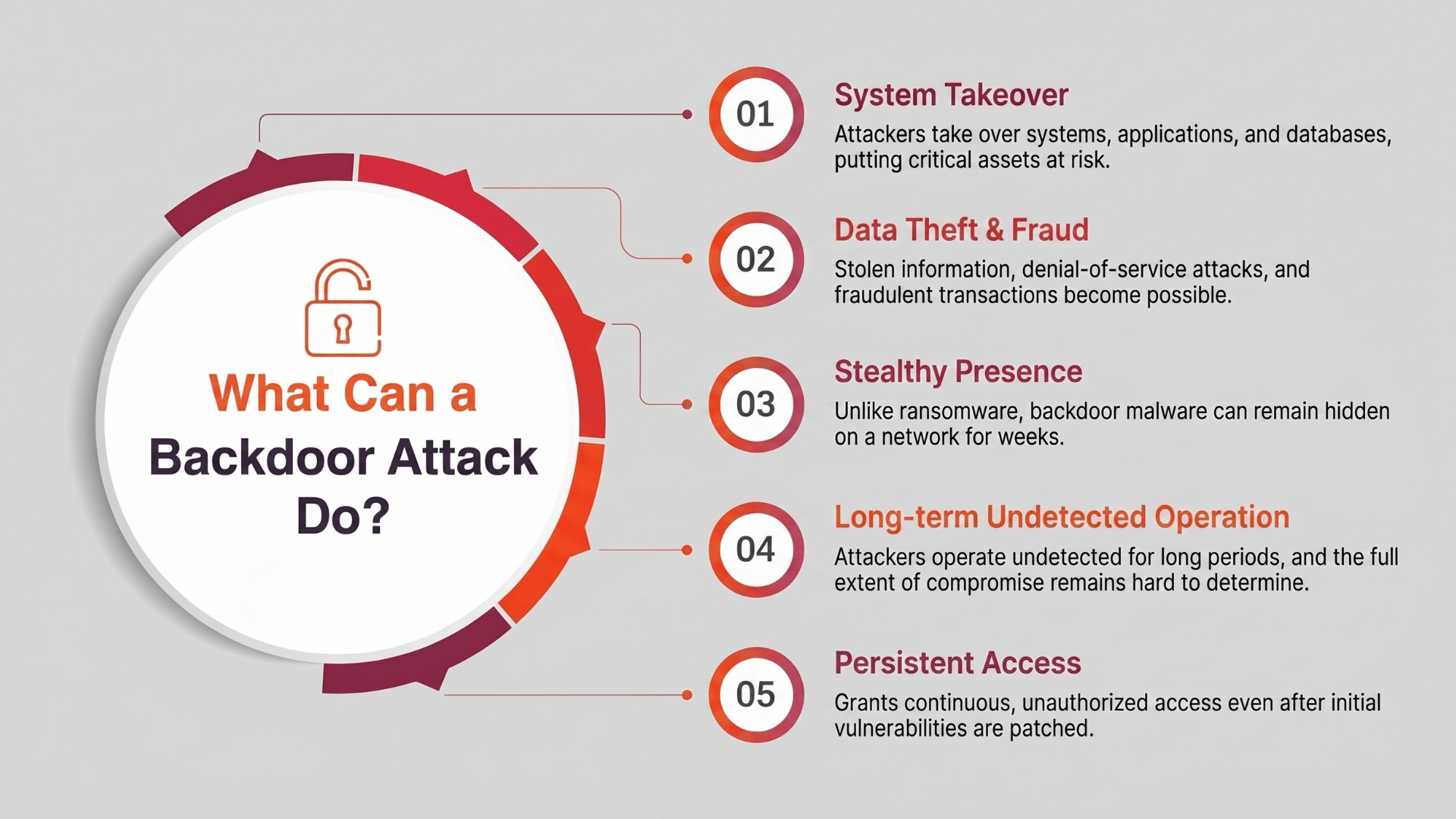
A backdoor attack allows attackers to gain unauthorized access to or remote control of a network.
- Attackers take over systems, applications, and databases, putting critical assets at risk.
- Stolen information, denial-of-service attacks, and fraudulent transactions become possible.
- Unlike ransomware, backdoor malware can remain hidden on a network for weeks.
- Attackers operate undetected for long periods, and the full extent of compromise remains hard to determine.
Backdoor attacks give hidden access, making networks vulnerable and hard to secure.
Notable Backdoor Incidents
History offers sobering lessons about the devastating impact of backdoor attacks, from large-scale espionage campaigns to the manipulation of critical infrastructure.
| Incident | Method | Impact |
|---|---|---|
| SolarWinds | Malware in Orion software update | Backdoor access to 18,000+ organizations, including government agencies |
| Microsoft Exchange | Exploited Exchange vulnerabilities | 65,000 servers vulnerable; thousands hit with ransomware |
| WordPress/PHP | Malicious code in the PHP script update | Remote takeover risk for millions of websites globally |
| Stuxnet | Zero-day vulnerabilities exploited | Industrial infrastructure damaged, redefining cyber warfare |
| VPNFilter | Malware surviving device reboots | Traffic intercepted, credentials stolen, attacks launched |
| Sony Pictures | Unauthorized internal network access | Mass extraction of confidential and employee data |
These incidents collectively compromised millions of systems worldwide, from government agencies to personal devices. The SolarWinds attack alone remained undetected for nearly 14 months, exposing just how silently and effectively backdoor attacks can operate.
How Does a Backdoor Attack Work?
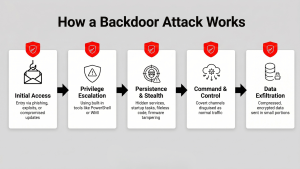
A backdoor attack typically follows a four-stage lifecycle. First, the attacker gains initial access through phishing emails, stolen credentials, or unpatched vulnerabilities.
Once inside, they install a backdoor mechanism, such as a hidden admin account, a web shell, or an embedded malware payload.
The attacker then establishes persistence through scheduled tasks, registry modifications, or encrypted communications, ensuring access survives reboots and security updates.
Finally, in the exploitation stage, the attacker operates freely, stealing data, deploying ransomware, or moving laterally across the network, often for months before detection.
Installation Methods
Attackers employ a variety of sophisticated methods to install backdoors:
- Malicious Software Distribution: Backdoors are delivered through phishing emails, compromised websites, or modified software packages.
- Software Vulnerability Exploitation: Attackers identify and exploit existing vulnerabilities in applications, often using automated tools to streamline the process.
- Network Protocol Manipulation: Weaknesses in network protocols are exploited to create backdoors that enable remote access while evading security monitoring.
- Social Engineering: Users are manipulated into installing compromised software disguised as legitimate applications or system updates.
Regardless of the method, the goal remains the same: to establish hidden, persistent access while avoiding detection.
Types of Backdoor Attacks
Backdoor attacks vary in form and complexity, each targeting different layers of a system to establish hidden, unauthorized access.
| Type | Description | Key Risk |
|---|---|---|
| Malware-Based | Opens remote access channels to C2 servers | Persistent unauthorized control |
| Web Shell | Malicious scripts enabling browser-based command execution | Difficult to detect post-compromise |
| Supply Chain | Inserted into legitimate software updates or libraries | Trusted software deploys a backdoor unknowingly |
| Hardcoded/Developer | Testing backdoors left exposed in production | Exploitable if discovered |
| Hardware & Firmware | Hidden access in physical components or system code | Nearly impossible to detect or remove |
| AI & Model | Manipulated training data triggering malicious outputs | Emerging, hard to identify |
Best Protection Strategies Against Backdoors
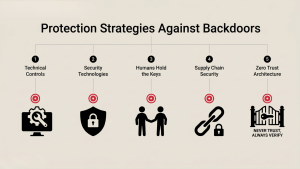
Protecting against backdoors requires a comprehensive strategy that combines technology, expertise, and human vigilance.
Read the list below to explore key protection strategies:
1. Technical Controls
The foundation of backdoor protection starts with robust security measures across an organization’s infrastructure. Essential controls include:
- Regular security assessments and vulnerability scanning
- Network monitoring and behavioral analysis
- Endpoint detection and response (EDR) solutions
- Up-to-date threat intelligence
2. Security Technologies
Modern security platforms work together seamlessly to detect and prevent backdoor threats. Key technologies include:
- Security information and event management (SIEM) for comprehensive monitoring
- Security orchestration, automation, and response (SOAR) for automated threat response
- Threat intelligence platform (TIP) for current threat information
- User and entity behavior analytics (UEBA) for detecting unusual activities
Pro Tip: Integrate SIEM, SOAR, TIP, and UEBA into a unified security ecosystem. Isolated tools limit effectiveness; combined, they enable faster detection and automated response.
3. Humans Hold the Keys
Technology alone can’t solve the backdoor problem. Organizations must build and maintain a strong security culture through systematic practices. Critical elements include:
- Implementing strong access controls
- Conducting regular security audits
- Maintaining detailed system documentation
- Training staff on security awareness
- Establishing incident response procedures
- Enforcing least privilege principles to limit user access to only what is necessary
4. Supply Chain Security
Backdoors are increasingly introduced through third-party software and vendors. Organizations must secure their supply chain by:
- Vetting third-party software and vendors before deployment
- Monitoring software updates and patches for integrity
- Implementing code signing to verify software authenticity
- Establishing strict vendor access controls and agreements
Real-World Example: Following SolarWinds, Microsoft launched its Secure Future Initiative, introducing Signing Transparency to deliver verifiable code integrity and tamper-evident software releases across its supply chain.
5. Zero Trust Architecture
Adopting a Zero Trust model ensures no user or system is trusted by default, significantly reducing backdoor risks. Key principles include:
- Continuously verifying user and device identity before granting access
- Segmenting networks to limit lateral movement
- Applying strict access policies based on context and behavior
- Monitoring all internal and external traffic without exception
Who is Behind Backdoor Attacks?
Backdoor attacks are carried out by a range of threat actors. Nation-state groups often target critical infrastructure and government networks to gather intelligence or disrupt operations.
Cybercriminals use backdoors for financial gain, stealing data, deploying ransomware, or committing fraud.
Malicious insiders can exploit their trusted access to install backdoors, often going unnoticed while compromising sensitive systems from within.
Each actor has different motives, but all leverage backdoors to maintain covert access and control.
Backdoor vs. Trojan vs. Remote Access Tool
Backdoors are often confused with other types of malicious software. Read the table below to understand the key differences between them.
| Type | Definition | Key Distinction |
|---|---|---|
| Backdoor | Hidden method of bypassing authentication for persistent access | Focused on maintaining long-term, covert access |
| Trojan | Malware disguised as legitimate software | May install a backdoor once executed |
| Remote Access Tool (RAT) | Software enabling remote system control | Legitimate tools can be abused; malicious RATs often function as backdoors |
Quick Takeaway: While Trojans deliver backdoors and RATs enable remote control, a backdoor is the hidden access point that ties them all together. Understanding the distinction is essential for accurate threat detection and response.
How to Detect a Backdoor Attack?
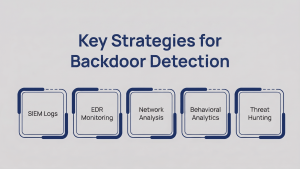
Detecting a backdoor attack requires continuous monitoring and behavioral analysis. Key detection strategies include:
- Centralized log collection and correlation through a SIEM.
- Endpoint detection and response (EDR) monitoring.
- Network traffic analysis for unusual outbound connections.
- Behavioral analytics to identify authentication anomalies.
- Threat hunting for persistence mechanisms.
Unusual administrative account creation, unexpected outbound traffic, or modified authentication logic can all indicate backdoor activity.
Best Tools to Detect & Fight Backdoor Attacks
Choosing the right security tools is critical to detecting and neutralizing backdoor threats before they cause lasting damage.
The following solutions are among the most trusted and widely adopted in the US market.
| Tool | Type | Best For |
|---|---|---|
| Splunk | SIEM | Log correlation and security monitoring |
| Darktrace | AI Threat Detection | Identifying unknown and stealthy backdoors |
| Palo Alto Cortex XDR | XDR | Cross-layer visibility across endpoints and the cloud |
| Microsoft Sentinel | SIEM/SOAR | Cloud-native monitoring and automated response |
| Tenable Nessus | Vulnerability Scanner | Detecting unpatched vulnerabilities and misconfigurations |
Final Thoughts
Backdoor attacks are silent, persistent, and increasingly sophisticated. The damage they cause, from stolen data to compromised infrastructure, can take years to fully uncover.
Understanding what is a backdoor is no longer optional for businesses navigating today’s threat landscape.
The right tools, a Zero Trust mindset, and a security-aware culture are your strongest defenses.
Start by auditing your current security stack and identifying gaps before attackers do.
Take the first step today, assess your vulnerabilities, implement the strategies covered here, and stay one step ahead of backdoor threats.
Have questions or experiences with backdoor attacks? Share your thoughts in the comments below.
Frequently Asked Questions
Can a Backdoor Attack Affect Personal Devices?
Yes, personal devices, smartphones, and home routers are equally vulnerable and often exploited as entry points into larger networks.
How Long Does a Backdoor Typically Go Undetected?
Without continuous monitoring, detection can take months or years. In the SolarWinds case, attackers went undetected for nearly 14 months.
Can a Backdoor Be Fully Removed Once Discovered?
Software backdoors can be patched and reimaged, but hardware or firmware backdoors may require full hardware replacement to be completely eliminated.